Book Club Apps: How to Run a Virtual Book Club That Actually Works
Published on May 19, 2026

Book clubs have a participation problem. Getting everyone to finish the book is hard enough. Getting everyone to show up at the same time for discussion is even harder. The clubs that thrive are the ones that find formats flexible enough to fit real life.
Why Traditional Book Clubs Struggle
In-person book clubs work beautifully when everyone lives nearby and has similar schedules. But life gets complicated. People move. Work hours shift. Kids get sick on meeting nights. Travel happens.
Video call book clubs seemed like the solution, but they've inherited the same problem: everyone still needs to be available at the same time. For groups spread across time zones or with unpredictable schedules, finding that overlapping window becomes its own project.
What starts as an exciting reading community slowly becomes another scheduling obligation. People drop out not because they've lost interest in books, but because they can't make it work with everything else in their lives.
Async Book Clubs: A Different Approach
An asynchronous book club removes the synchronous requirement entirely. Instead of gathering at a set time, members share their thoughts whenever they've finished reading. Others respond when they catch up.
This works because book discussion isn't actually time-sensitive. Unlike breaking news or live events, reflections on a chapter don't expire. Someone sharing their thoughts on Tuesday and getting responses on Thursday is just as valuable as everyone talking at once.
The format also accommodates different reading speeds. Fast readers can share early thoughts while others are still reading. Slow readers can join the discussion when they finish without feeling left behind.
Why Voice Works for Book Discussion
Text-based book clubs exist in plenty of Discord servers and Slack channels. They work, but they lose something in the process.
Book discussion is naturally conversational. People riff off each other's ideas, share emotional reactions, make connections between themes and their own lives. This flows easily in spoken conversation but feels stilted when typed.
Voice lets members share genuinely. A three-minute voice message can capture excitement, confusion, disagreement, and nuance in ways that would take paragraphs to type. And most people can record while doing other things, making participation fit more easily into busy days.
Listening is similarly flexible. Catching up on what other members thought while commuting or cooking makes book club participation feel light rather than like homework.
Setting Up a Voice-Based Book Club
The basic structure is simple:
Create a private channel for the group. This becomes your ongoing discussion space. Only invited members can access it.
Set reading milestones. Rather than finishing the whole book at once, break it into sections. "Share thoughts on chapters 1 through 5 by Friday" gives structure without requiring synchronous attendance.
Seed discussion with prompts. Someone can post a few questions or observations to get conversation started. Others respond with their own takes.
Use threaded replies for tangents. When a discussion goes deep on a particular point, keep it threaded so members can follow or skip based on interest.
Optionally meet live for big moments. Some clubs schedule a video call for the book's finale, combining async discussion throughout with a synchronous capstone. Others stay fully async.
Tips for Running an Async Book Club
A few practices help async book clubs thrive:
- Mark spoilers clearly. When discussion spans people at different points in the book, flagging plot reveals prevents frustration.
- Keep prompts open-ended. Yes/no questions don't spark conversation. "What did you think about the narrator's decision?" works better than "Did you like chapter 3?"
- Celebrate participation, not perfection. Someone sharing a half-formed thought keeps the group alive more than waiting for polished takes.
- Rotate who posts discussion prompts. Shared ownership keeps the group from depending on a single organizer.
Roads Audio for Book Clubs
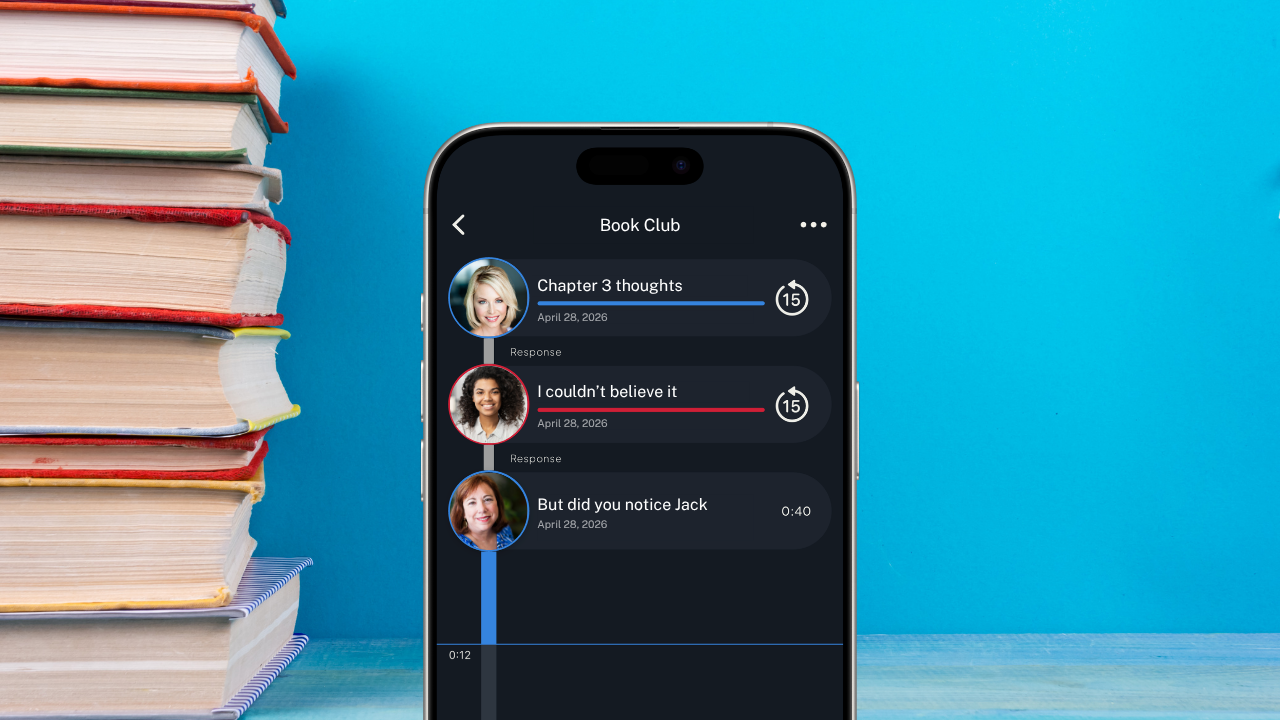
Roads Audio provides a natural home for voice-based book clubs. Create a private channel, invite your reading group, and use it as your ongoing discussion thread.
Members share their thoughts on chapters through voice messages. Others listen and respond when they've caught up. Threaded replies let conversations branch without losing the main thread. The whole history of your discussion stays organized.
For book clubs with members across time zones or with unpredictable schedules, the async format means everyone can participate meaningfully without coordinating calendars.
Learn more about the format in our guide to what micro podcasts are and how they work for small communities.
Books Bring People Together
The best part of a book club isn't just reading; it's discussing. Hearing how others interpreted the same pages. Discovering perspectives you missed. Connecting over shared reactions.
When scheduling becomes the barrier to that connection, the format needs to change. Async voice discussion keeps the conversation alive without requiring everyone to show up at once. For readers tired of clubs that fizzle because meeting times never work out, it's an approach worth trying.
Try Roads Audio Free Today
Start a voice-based book club that fits everyone's schedule. Create a private channel, invite your reading group, and start discussing.